MORE ABOUT WATER TO THE WATER HEAT EXCHANGER
Before moving ahead to water to the water heat exchanger, let’s understand the basics behind
heat exchangers and their functioning. When there is an exchange of heat between two or
more fluids or gases, the heat transferring process takes place. The process happens between
liquid to liquid, gas to gas, liquid to gas wherein the two elements do not mix. The hotter fluid
comes in contact with the cold one either directly or indirectly during the heat transferring
process. The temperature of the hotter gas or liquid decreases and the temperature of the cold
one increase. It depends all on the intention of the application either it wants to heat or cool.
heat exchangers and their functioning. When there is an exchange of heat between two or
more fluids or gases, the heat transferring process takes place. The process happens between
liquid to liquid, gas to gas, liquid to gas wherein the two elements do not mix. The hotter fluid
comes in contact with the cold one either directly or indirectly during the heat transferring
process. The temperature of the hotter gas or liquid decreases and the temperature of the cold
one increase. It depends all on the intention of the application either it wants to heat or cool.
The principle of a heat exchanger is that it doesn’t transfer the liquids or gases that carried the
heat. For example, a hotter gas or liquid is not mixed with the colder one to reduce or increase
the temperature of the colder one. The heat exchangers are made of ceramics, metals, plastics,
and composites. The high-temperature applications between 1000 degrees to 2000 Fahrenheit
melt the metals like copper iron and steel. Hence in such cases ceramic is highly useful and
recommended. Plastics are preferred over metals for their resistance to corrosion, low cost,
and thermal conductivity. But for high-temperature applications, plastics are not suitable.
heat. For example, a hotter gas or liquid is not mixed with the colder one to reduce or increase
the temperature of the colder one. The heat exchangers are made of ceramics, metals, plastics,
and composites. The high-temperature applications between 1000 degrees to 2000 Fahrenheit
melt the metals like copper iron and steel. Hence in such cases ceramic is highly useful and
recommended. Plastics are preferred over metals for their resistance to corrosion, low cost,
and thermal conductivity. But for high-temperature applications, plastics are not suitable.

Plastics are used in water-related applications such as swimming pools. Water to water heat
exchangers involved liquid to liquid heat exchangers. Water heat exchangers use the heat of
the wastewater to heat the freshwater entering into it.
exchangers involved liquid to liquid heat exchangers. Water heat exchangers use the heat of
the wastewater to heat the freshwater entering into it.
Water to water heat exchangers is used for commercial as well as industrial purposes. They are
also used for snow melting, solar heating, and hot water heating for domestic purposes. Shell
and tube heat exchangers are famous for use in swimming pools and marine applications.
There are considerable savings when such exchangers are used.
also used for snow melting, solar heating, and hot water heating for domestic purposes. Shell
and tube heat exchangers are famous for use in swimming pools and marine applications.
There are considerable savings when such exchangers are used.

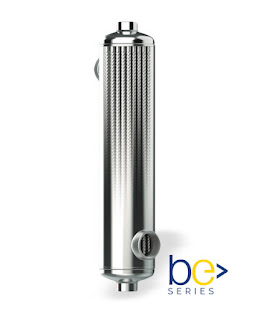
Shell and tube heat exchangers and plate heat exchangers are commonly used types of water-
to-water heat exchangers. The former has a single tube or a series of tubes running parallel to
each other. The tubes are covered in a cylindrical vessel known as the shell. The fluid flows
from tubes and the other fluid flows between the tubes, thus transferring the heat to each
other. Some shell tube has finned tubes single or double phase heat exchanger, concurrent
flow, countercurrent flow, etc.
to-water heat exchangers. The former has a single tube or a series of tubes running parallel to
each other. The tubes are covered in a cylindrical vessel known as the shell. The fluid flows
from tubes and the other fluid flows between the tubes, thus transferring the heat to each
other. Some shell tube has finned tubes single or double phase heat exchanger, concurrent
flow, countercurrent flow, etc.

Plate heat exchangers are prepared from thin corrugated plates tied together. This is used to
transfer heat from medium and low-pressure liquids. Where the more closed product is
required, welded, semi-welded heat exchangers are used. There is a large surface area which is
much efficient than a shell and tube exchanger. This is the most efficient as high turbulence
flow is possible on both sides. Brazed plate heat exchangers are used in HVAC applications for
refrigerating purposes. City sewers are used to treat wastewater by water to water heat exchangers.
transfer heat from medium and low-pressure liquids. Where the more closed product is
required, welded, semi-welded heat exchangers are used. There is a large surface area which is
much efficient than a shell and tube exchanger. This is the most efficient as high turbulence
flow is possible on both sides. Brazed plate heat exchangers are used in HVAC applications for
refrigerating purposes. City sewers are used to treat wastewater by water to water heat exchangers.
There are also standard plate designs such as plate fin or pillow plate heat exchangers. The pressure is applied to the plates to increase the efficiency across the plate’s surface. https://aicheatexchangers.com

Comments
Post a Comment