Know More In Detail About The Marine Heat Exchanger
The heat exchanger is defined as equipment that lowers the temperature of a media by transporting the temperature of that media to another when both the mediums are divided by a solid membrane or wall-like structure. For effective functioning, the surface area of the wall which divides the two mediums is maximized, simultaneously minimizing the resistance to the flow of the fluid.
One such common heat exchanger has to be the marine heat exchanger, which is mostly used for cooling down the engine of the boat with the help of water from the river, lake, or the ocean in which the boat has been anchored. As the water-antifreeze solution passes through the entire heat exchanger, it releases heat while staying separate from the corrosive salts and chemicals present in the water in which the boat is afloat.
A Marine heat exchanger is often used to transmit the heat from the water-antifreeze mixture to the water content that flows through the heat exchanger. As distilled water and antifreeze are potentially corrosive, it is possible to cool the engine with a sealed mixture of the two substances. The Heat Exchanger can be changed at a fraction of the expense of replacing the engine if the ocean water finally corrodes and destroys the unit.
Types of Marine Heat Exchanger
The tube-shell and plate heat exchangers are by far the most prevalent forms of heat exchangers used on ocean-going vessels, regardless of the fact that there are various types of heat exchangers that are employed on the ground.
1. Shell-Tube
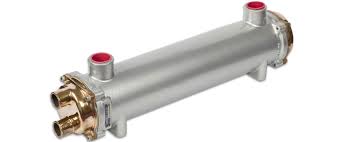
These types of heat exchangers are constructed by inserting one or more tube bundles into a larger shell. Maintenance of these heat exchangers is complicated by the fact that they require twice the space of a standard heat exchanger. Shell and tube heat exchangers can be constructed in either a single or double pass arrangement, depending on the required cooling quantity.
The term &number of passes " corresponds to the number of times the liquid in the shell travels by the fluid in the tubes throughout its circulation. Using baffles in the shell can be accomplished by directing fluid flow in a certain direction.

2. Plate
When it comes to the marine heat exchanger, plate-type units are constructed from sets of several parallel plates that are crushed together to form the main cooler unit. Compared to other forms of heat exchangers, this type has a modest footprint. It is intended that when the plates are positioned close to each other, they will form pathways for the fluid to pass through between the plates. Gaskets are installed around the edges of each plate to prevent the two fluids from mixing. Plate-type heat exchangers are utilized for low pressure and low- temperature applications, under 20 bar and 300 degrees Fahrenheit.
AIC offers the best heat exchanging solutions at a very affordable price. You can visit us at https://aicheatexchangers.com/ to learn more about what we have stocked for our clients who are looking for a marine heat exchanger and much more!
.jpg)
Comments
Post a Comment