What Are The Types and Uses Of Sanitary Heat Exchangers?
Working with sanitary applications necessitates prudence, attention to detail, and a commitment to excellence. To work efficiently, food, beverage, and pharmaceutical processing systems require the addition and removal of heat. Operations must be carefully managed to maintain proper temperatures. Heat exchangers aid in the regulation of fluid temperatures in food, beverage, and pharmaceutical processing for pasteurization, sterilization, clean-in-place, and other sanitary activities.
In the food, beverage, and pharmaceutical industries, heat exchangers are used to transfer heat between two or more fluids in order to control temperature.
● Food and Beverage Industry: Sanitary Heat exchangers keep items safe for consumption and lengthen the shelf life by inhibiting the growth of hazardous bacteria.
● Milk processing: Heat exchangers pasteurize milk by increasing the temperature of the milk.
● Pharmaceutical processing: To maintain product safety and quality, materials in cosmetics and medicines must be blended at specific temperatures. Sanitary heat exchangers decrease or remove microbial in the food and beverage sector to make products safe for consumption and avoid spoiling. Heat exchangers also heat or cool materials throughout various processing phases, such as filling, drying, and concentration.
.jpg)
Heat exchangers utilize creative designs to enhance efficiency to fulfill processing needs for different viscosities of a wide range of goods.
In this post, we'll look at three different forms of heat exchangers: plate and frame, shell and tube, and scraped surface.
1) Plate And Frame Heat Exchanger:
Plate and frame heat exchangers are constructed of corrugated plates mounted on a frame. This design generates a lot of turbulence and a lot of wall shear stress, resulting in a lot of heat transfer coefficient and fouling resistance. Within the heat exchanger, fluids circulate.
The two streams are now flowing in opposite directions. Hot fluid runs down one plate while cold fluid flows up the other.
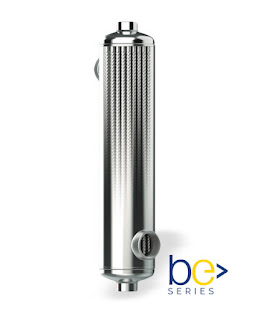
2) Shell And Tube Heat Exchanger:
Heat is transferred between fluids that travel through a bundle of tubes and fluids within a massive shell vessel that covers the tubes in shell and tube heat exchangers. Tubes inside the shell allow for more viscous or particulate-containing fluids processing than a plate and frame heat exchanger.
3) Scraped Surface Heat Exchanger:
Heat transmission to very viscous and sticky goods is required in several applications. Scraped surface sanitary heat exchangers are the most significant way to provide good heat transfer in certain situations because the scraping blades prevent the product from collecting on the inside surfaces.
Uses Of Sanitary Heat Exchangers:
Heat exchangers are valuable in the pharmaceutical, food, and beverage industries in various ways:
● Heat exchangers heat cleaning fluids, which remove debris from system components.
● They maintain stable temperatures for pasteurization and clean-in-place processes (CIP).
● They heat water to rinse food processing equipment effectively.
● They may be mounted on the skids for compact and versatile CIP equipment placement.
● Heat exchangers may be cleaned because their designs create turbulence when systems maintain a sufficient flow rate.
● They provide heat transmission without polluting the heated fluids.
● Regenerative heat transfer saves energy by reusing heated fluids to heat fluids in repeating cycles.
● They maintain stable temperatures for pasteurization and clean-in-place processes (CIP).
● They heat water to rinse food processing equipment effectively.
● They may be mounted on the skids for compact and versatile CIP equipment placement.
● Heat exchangers may be cleaned because their designs create turbulence when systems maintain a sufficient flow rate.
● They provide heat transmission without polluting the heated fluids.
● Regenerative heat transfer saves energy by reusing heated fluids to heat fluids in repeating cycles.
Conclusion:
If you work in the food, beverage, and pharmaceutical industries, sanitary heat exchangers are must-add equipment for your company. Do you already own any heat exchangers, or are you planning to invest in a new one?


Comments
Post a Comment